
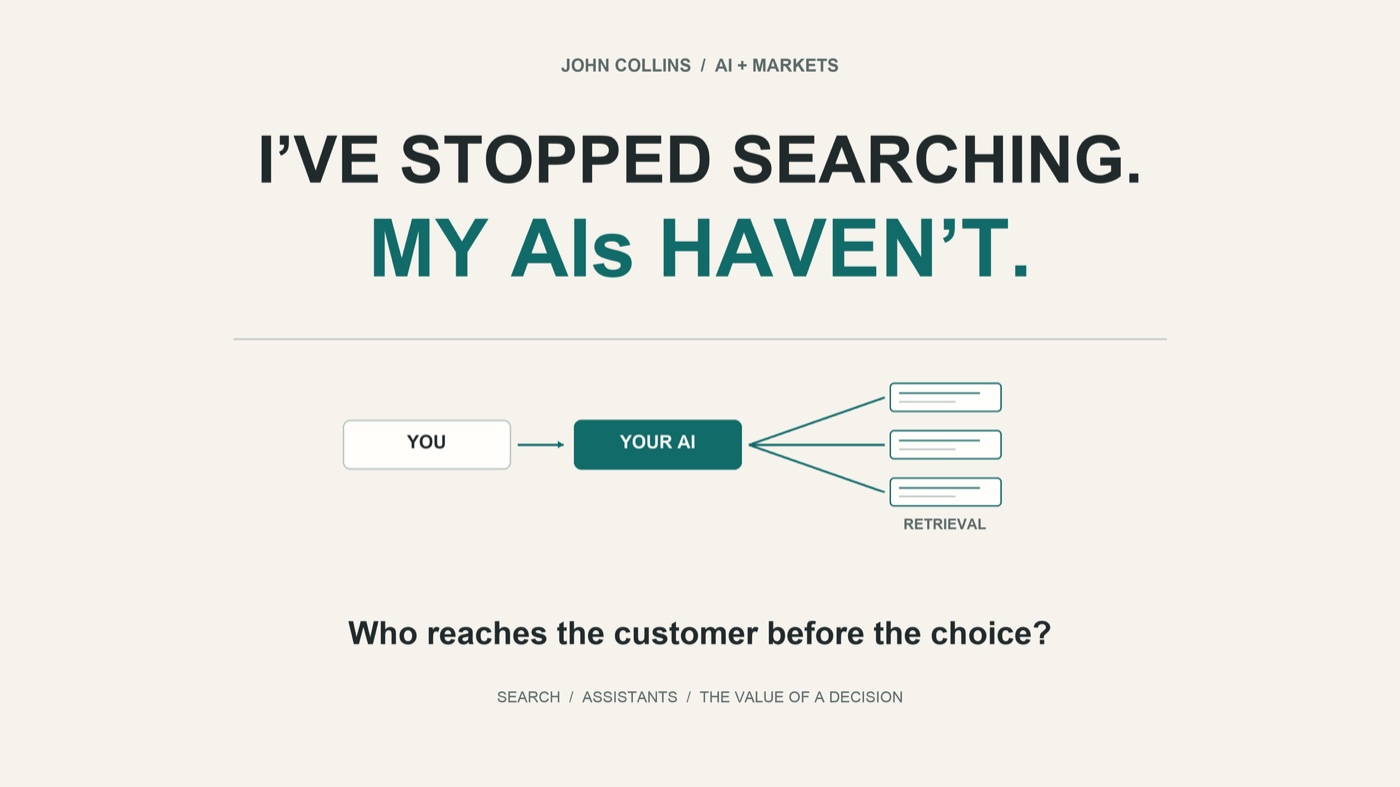
I no longer use a search engine. I work through ChatGPT on the Mac, Grok and Claude. They search extensively while doing work for me, sometimes following instructions, sometimes deciding for themselves that they need more information. Direct search has been dead at our desk for quite some time.
This is one desk, not a survey. But it exposes something rather important about the “death of search” argument. Search can disappear from the user’s workflow while remaining essential to the work.
Google has just suffered its worst daily percentage fall in the available history back to its IPO: GOOG fell 12.3% on 29 October. Has the market finally noticed what people like us are doing? Perhaps. But a share-price fall cannot tell us, by itself, what future the market has priced. Price history
Start with the business. Google’s Search and other revenue grew from $56.6bn to $63.4bn in the third quarter. Paid clicks rose 8%; cost per click rose 4%. Search revenue growth has nevertheless slowed from about 19% in Q1 to 17% in Q2 and 12% in Q3. Those are the numbers of a growing business with slowing growth. They neither establish extinction nor rule out displacement. Alphabet Q3 filing
On the call, management acknowledged that AI Mode’s lower monetisation was contributing to Search’s deceleration. Currency, it said, made the largest contribution to the slowdown from Q2; it also cited retail conditions and comparisons with the World Cup quarter. It did not quantify each contribution. There is a real transition here, but attributing the entire slowdown to agents would be convenient rather than rigorous. Earnings call, 36:25
The more interesting question is what happens before a purchase.
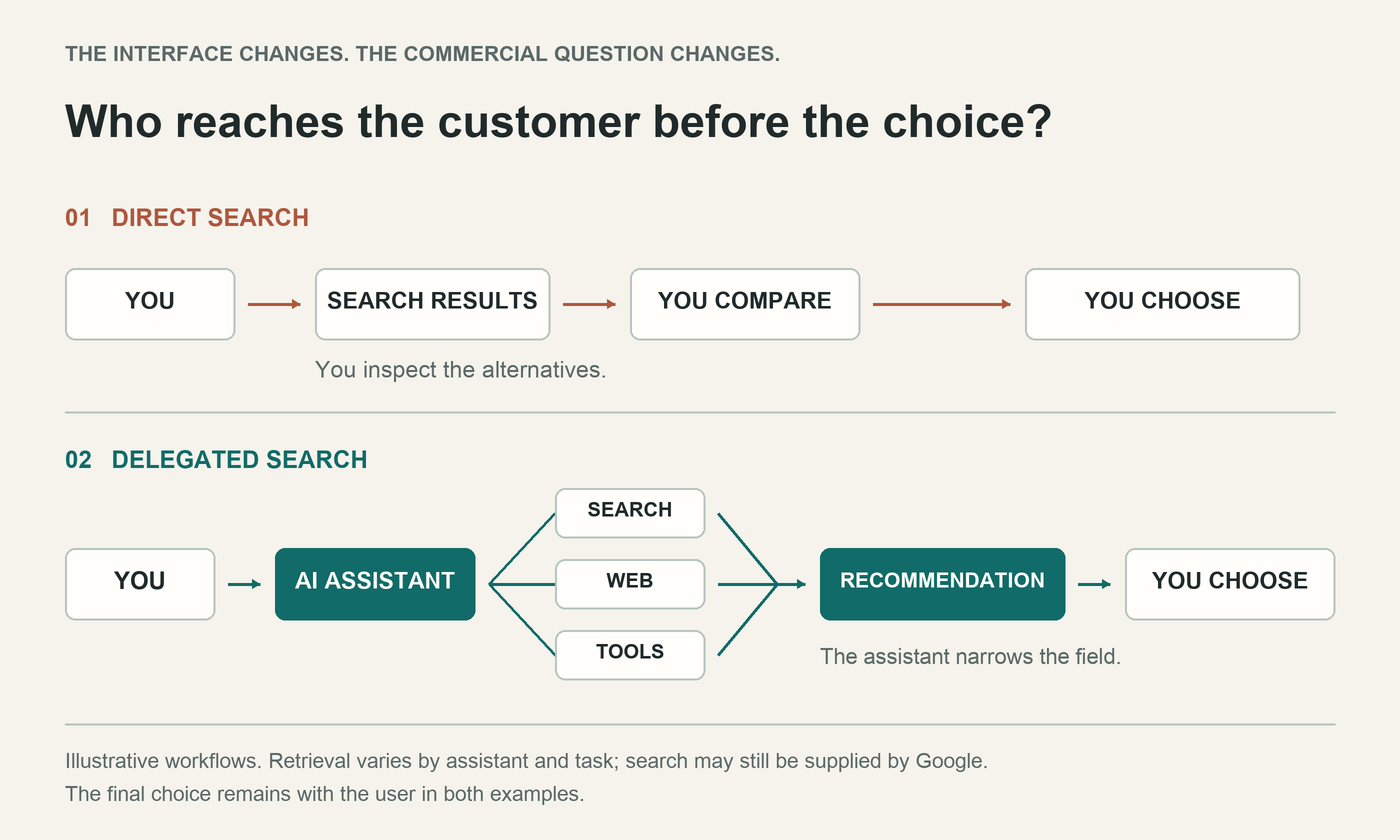
Suppose I ask an agent to find a suitable hotel. It can search, read reviews, compare locations, check availability and return a recommendation. Quite a lot of retrieval may happen. Very little of it needs to become a page of results that I inspect.
By the time I reach the hotel’s website, the decision may largely be made. The assistant does not even need to charge the hotel a fee for an advertising opportunity elsewhere to have disappeared. And a search provider getting paid for retrieval would not, by itself, preserve the economics of reaching a person while they are choosing.
This is why counting searches is insufficient. The work can grow while the opportunity to influence the customer moves. Nor should we assume that every search performed by an assistant goes through Google. The provider, tools and route vary.
One answer on Google’s call was unusually revealing. Philipp Schindler described how Google would “intentionally design the time and the space for users to explore those choices” inside agentic experiences. He described useful comparisons between alternatives, including insurance terms, and connected that to advertising. Earnings call, 51:45
That is the commercial problem stated remarkably plainly. Automate the research, but retain a place where the customer can compare and choose. Useful choice is valuable to the user. It is also where an advertiser has a reason to pay.
Google understands this. On 28 October it announced AI Mode advertising in ten additional countries and ads in follow-up conversations in the US. It has advertisers, merchant relationships and measurement systems already in place. The question is how effectively those assets transfer to the new experience. Google’s announcement
Meta makes the distinction easier to see. Its advertising revenue grew about 26% in Q3. Its engineering work describes large models learning patterns that can then be reused by smaller systems serving ads. Some of the expensive intelligence can be spread across many subsequent decisions. The existing commercial machinery benefits without requiring every advertiser or user to adopt a new interface. Meta results; GEM architecture
Google does plenty of this too. Its additional challenge is that AI changes where some of its most valuable customer interactions happen. Meta’s own agents will face related questions. Neither company publishes enough detail to declare a winner on fully loaded AI returns.
Back to the sell-off. There were genuine disappointments: Search missed a published pre-results forecast, and cash generation was weaker than that forecast despite capital spending coming in below it. This cannot all be dismissed as capex hysteria. Dated preview; Reported results
But consider this: Investing.com reports that Susquehanna cut its Alphabet price target from $460 to $400 while raising its 2027 GAAP earnings-per-share forecast by 2%. Lower valuation; higher forecast earnings. That is a much more useful description of the argument than “Search is dead”. Investors can disagree sharply about the durability and value of profits without forecasting their disappearance. Reported broker revisions
For the next few quarters, I would watch who retains the commercial decision, what Google earns from comparable tasks, and what it costs to complete them. More queries alone will not answer that. Neither will an impressive demonstration or one quarter’s share-price reaction.
There is a practical implication for anyone selling something, too. An agent may increasingly decide which alternatives your customer ever sees. Being easy for a person to find and being selected by their agent are different problems.
I haven’t stopped needing search. I’ve stopped being its audience.
Research as of 30 October 2026.