

A company can adopt AI, pay its AI bill and do the same work at half the cost without earning another dollar of profit. That matters rather a lot if we’re using earnings across the rest of the stock market to decide whether the AI build-out makes sense.
Take an illustrative job that costs $100 to deliver and sells for $120. AI reduces the all-in cost to $50, including a $10 AI bill. Competition pushes the selling price down to $70. The company still earns $20. Its customer saves $50. The AI provider gets paid $10. Same job, same profit, very different economics.
An analyst can leave the company’s earnings estimate unchanged without disputing any of that. The gain has reached the customer. It hasn’t disappeared.
Recent institutional research brings two questions into focus. WisdomTree revisits the idea that infrastructure booms become dangerous around cumulative spending of 25% of GDP, while calling it an observation, not a law. Goldman Sachs estimates that AI investment accounts for nearly half of this year’s S&P 500 earnings growth. Those are important questions. But we also need to ask where the gains go. WisdomTree, 23 September · Goldman Sachs, 23 September
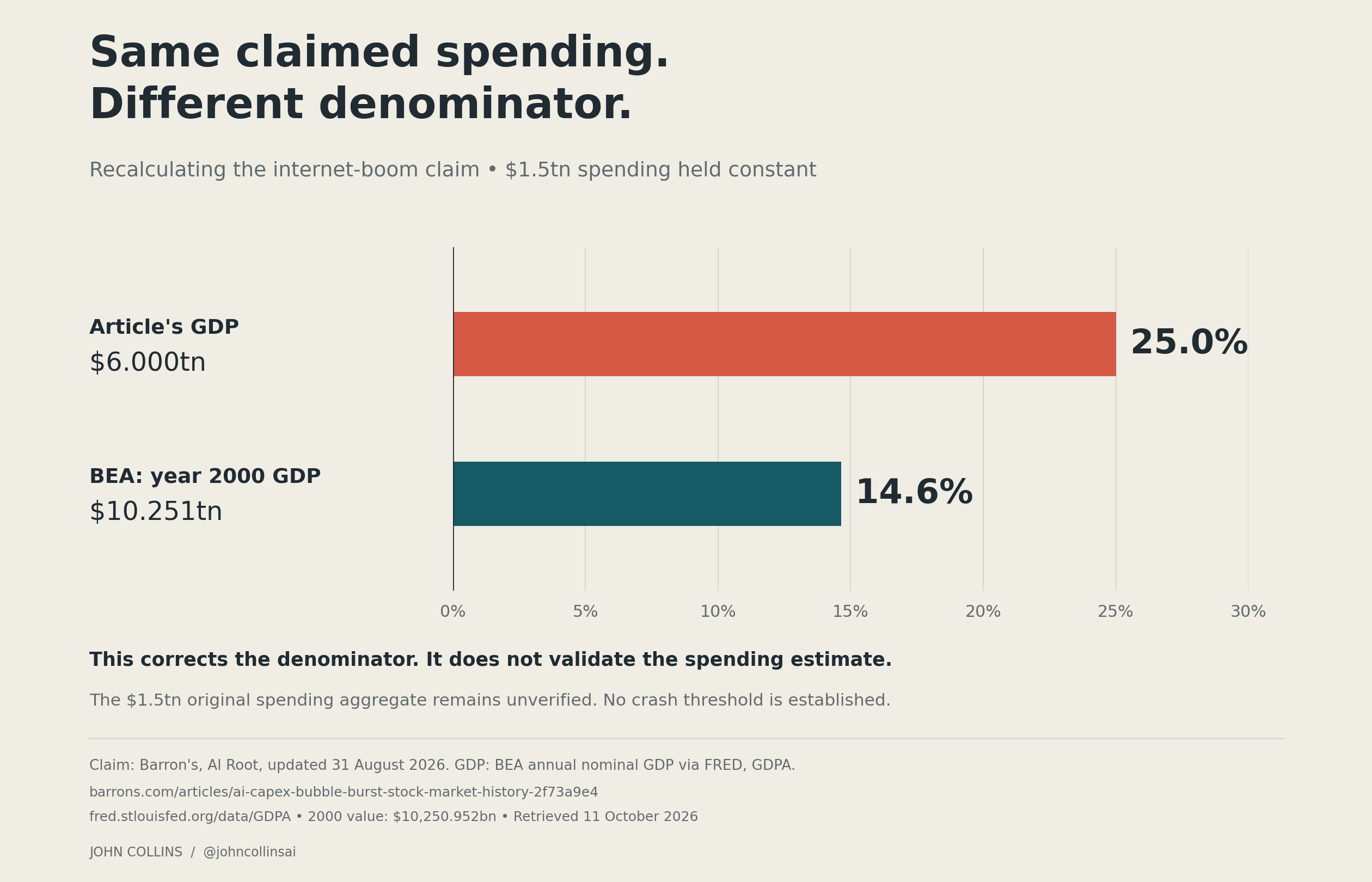
First, the historical calculation. The Barron’s analysis behind the 25% claim pairs approximately $1.5tn of internet investment with a $6tn US economy. The US economy was about $6tn in 1990. By 2000 it was $10.25tn. Keep the claimed spending unchanged and the ratio becomes 14.6%.
That doesn’t establish the right total for internet investment; the original spending definition remains unclear. It does establish that a rather consequential denominator needs explaining before anyone uses the comparison to date the next crash. A fixed starting-year denominator could be a deliberate choice. It would need to be stated and applied consistently. Barron’s · BEA GDP series
In his recent interview with Sonali Basak, Torsten Slok asks when the rest of the S&P 500 will show the returns from adopting AI. He is bullish on its economic potential, while questioning how quickly investment pays off. A useful discussion. I’d add a distinction: the value customers receive and the extra profit they retain are different things. iCapital, 1 October
Concentrated earnings growth can still be consequential. I wouldn’t wave it away. But an earnings-revision chart cannot tell us whether customers are getting value from AI, where that value goes, or how much was already in the forecast.
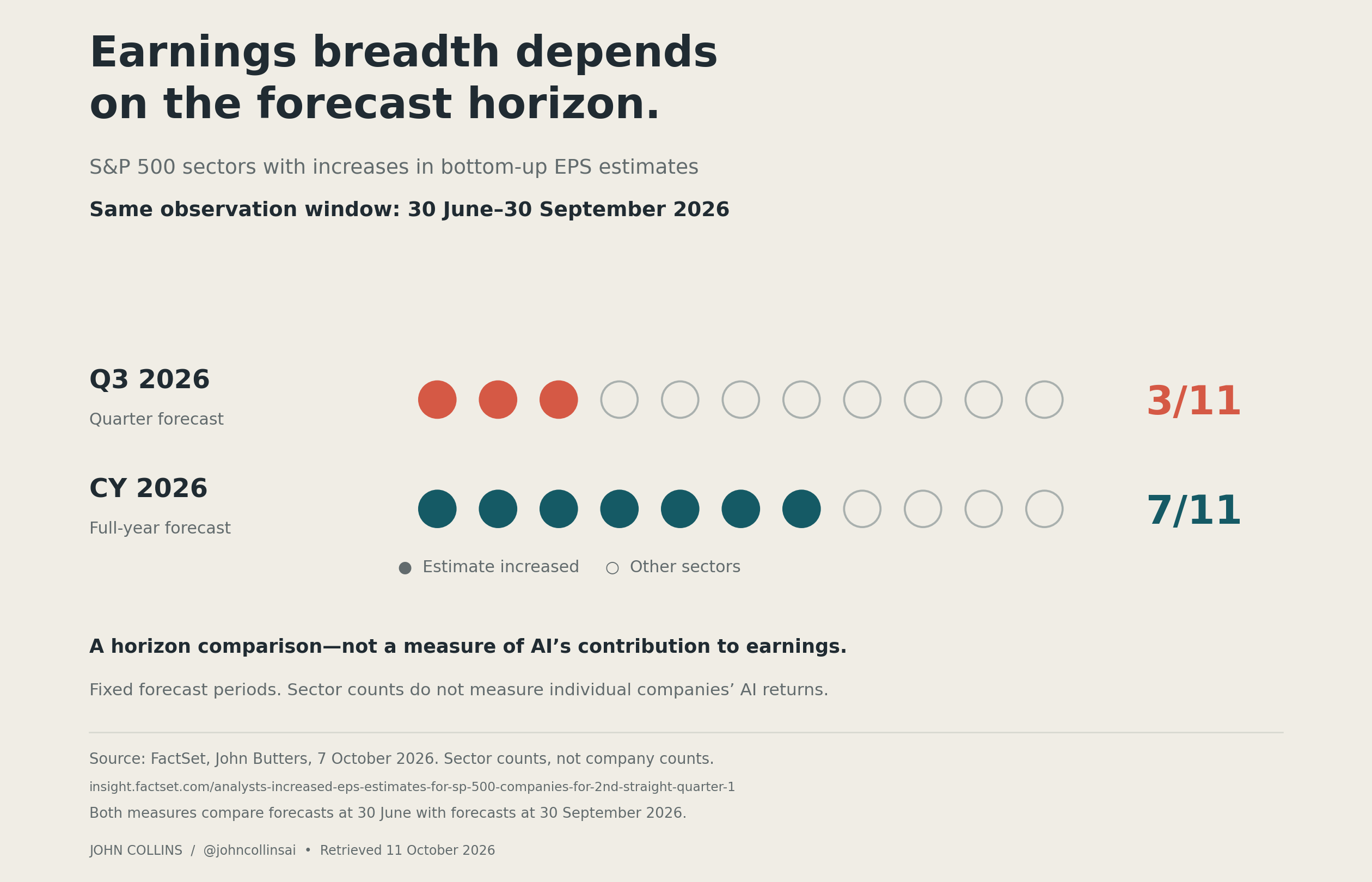
Even the breadth looks different when the question changes. FactSet reports that three sectors raised Q3 earnings estimates between June and September, while seven raised their estimates for the full year. Same observation period, different forecast horizon. Neither number measures the return on AI. FactSet, 7 October
There are actual businesses describing why useful AI needn’t immediately expand their margins. JPMorgan’s COO says the bank intends to reinvest capacity released by productivity gains in growth. Other businesses may cut prices, improve service, or use AI simply to keep customers who would otherwise leave. A successful challenger may take profit from an incumbent. Add the two together and the sector total can conceal a great deal of change. JPMorgan
To my mind, this is the more interesting point. Some of the money paying for AI can come from spending that already exists: software, outsourced work, service delivery. It doesn’t all require a new pool of corporate profit to appear first. Nor does useful adoption require every buyer to retain the saving. In a competitive industry, refusing to adopt may be how you lose the existing profit.
There is another moving part. The productive capacity of the infrastructure itself keeps changing. Microsoft reported a fourfold increase in Copilot workload throughput since the start of the year, and said additional Azure capacity delivered during the quarter was quickly monetised. Those are management disclosures, not proof that an unchanged machine suddenly earned four times as much. They do show why counting historical dollars spent is an incomplete account of what the system can now do. Microsoft, 29 July
History is useful here, btw, but the useful lesson is less comfortable than a 25% rule. The Richmond Fed’s telecom study describes rapidly growing traffic alongside a roughly fortyfold increase in capacity per fibre between 1996 and 2000. Demand could grow very quickly while supply grew faster. For AI, better models can create new paid work; better systems can also deliver existing work with fewer resources. We need to measure both. Exponential use alone doesn’t settle the return on the next build. Richmond Fed
I don’t find either a GDP threshold or narrow earnings upgrades a convincing reason to declare the AI build-out irrational. The case has to reach the actual work, its cost, the customer’s payment and the return left for the capital that supplied it. That can support substantial investment even while some existing businesses lose their economics.
If the argument is that too much capacity is being built to earn an adequate return, show where paid demand, prices and costs stop covering it. That is a case worth examining.
The customer can keep the saving while the supplier gets paid. An unchanged earnings forecast does not make either disappear.