
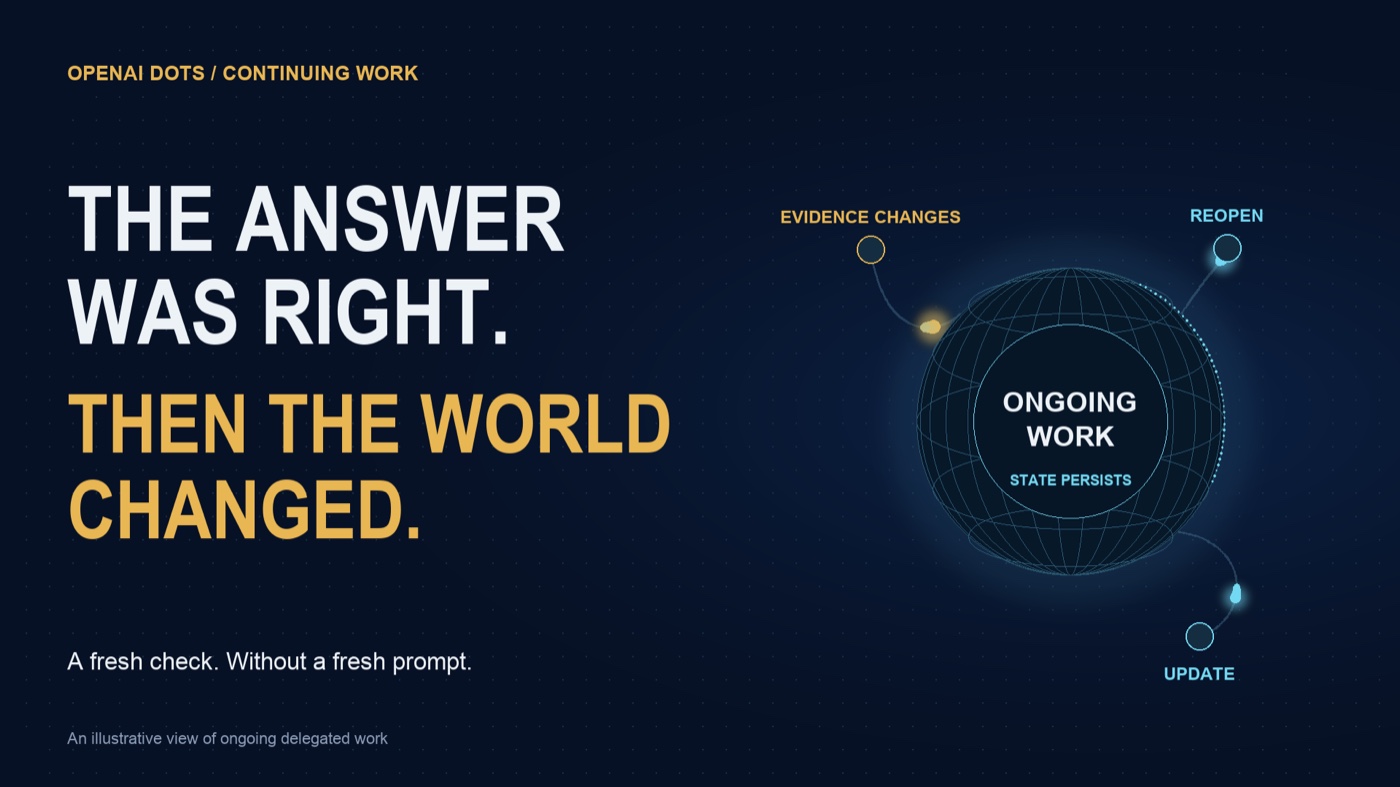
I think the most interesting thing about OpenAI’s Dots is what happens after the AI has given you a good answer.
In finance, engineering and most serious work, a good answer has a shelf life. A supplier changes a delivery date. A contract is amended. New evidence undermines a conclusion written last week. The old answer is still sitting there, beautifully sourced and quietly becoming expensive.
Someone has to notice. An AI can produce entirely accurate updates and still miss the one development it was meant to catch. No hallucination is required. Even when AI does the analysis well, a person can still be left doing the remembering, restarting and joining up. You could delegate the analysis and still find yourself managing every return visit.
That is the opportunity I see in Dots. The interesting product is a responsibility that can remain active after the conversation ends.
OpenAI describes an Astra-powered agent with its own cloud computer, connected tools and persistent notes. Its documentation goes further than scheduled reminders: a dot can decide when to pause and wake again, divide work among background agents, and connect new information to earlier work. Introducing dots Tasks and memory
Agents, memory and background tasks are not new, btw. OpenAI explicitly acknowledges that. ChatGPT agent already had computer use and recurring tasks; Pulse already offered proactive research. The potential inflection is making continuing delegation usable in one place, with much less of the coordination left to the person using it. GPT-6 Astra system card, Dots appendix Introducing ChatGPT agent Introducing ChatGPT Pulse
Consider a simple example. You ask whether a factory expansion can meet a customer’s delivery date. The analysis is sound and the answer is yes. Three days later, an equipment supplier revises its schedule.
A useful continuing assignment would notice the revision, identify which assumption it breaks, check whether another route remains feasible and bring back the consequence.
This is a design standard, not a claim that Dots automatically supplies a complete dependency map. But it shows why the opportunity is much larger than generating another report. The valuable output may be: the report you already have is no longer safe to rely on.
Technically, that asks quite a lot of memory. Remembering the previous answer is insufficient. A system needs the evidence supporting it, when that evidence was checked, what remained unresolved, and what would require the conclusion to be reopened. It also needs to know what it is currently authorised to do. Yesterday’s permission can expire just as yesterday’s assumption can fail.
This is durable state outside the model’s weights. It is not synonymous with a long context window, or the KV cache used during inference. OpenAI distinguishes conversation context, ChatGPT memory and a dot’s own notes; delegated tasks receive selected context rather than automatically inheriting every conversation. Tasks and memory
More memory is therefore only part of the answer. A system that faithfully remembers an obsolete conclusion can become more confidently wrong. The useful capability is remembering why it believed something and recognising when that reason no longer holds.
There is another technical detail worth noticing. OpenAI describes Dots in terms of both a time budget and reasoning effort. Keeping a responsibility open for a week is different from spending a week generating tokens. Useful work may involve short checks, waiting for evidence, a burst of parallel investigation and then a decision. Persistence is about the continuity of the assignment; it need not mean uninterrupted inference. GPT-6 Astra system card, Dots appendix
There is a great deal of work we would like kept current but cannot justify asking someone to revisit repeatedly. The individual check might be cheap. Remembering all the checks, deciding which matter and following through is expensive.
If that cost falls enough, we can maintain more investigations, test more alternatives and discover changes we would otherwise have missed. The saving creates room for work that previously did not get commissioned at all. That is where I think the comparison with ChatGPT becomes serious: another reduction in the effort required to put intelligence to use.
One standing responsibility can generate many bouts of reasoning without another human prompt. User screen time becomes a poor proxy for work undertaken. A more useful demand measure becomes the responsibilities maintained, the changes they encounter, and the work required to keep them valid.
That has implications for compute, durable storage, memory movement and the cost of supervision. It does not mean every dot needs a permanently occupied GPU, or that every saved note sits in HBM. Efficient retrieval and scheduling can reduce the resources required per assignment while making more assignments worth maintaining. Whether total demand expands depends on how much useful work people actually delegate.
The test will also have to change. Alongside the quality of the work returned, I would want to know which material changes were missed, how long conclusions remained stale, and how much human effort went into checking and repairing the work. A busy agent is not necessarily carrying much responsibility.
There is a useful distinction in how OpenAI has built this. Proactive research uses read-only tools. Acting on what it discovers is a separate step, subject to authority and action review. The environments executing code are separated from the systems coordinating the work and enforcing safeguards. Remembering that something needs doing does not give an agent permission to do it. That separation can make broader delegation practical without requiring a person to supervise every keystroke. How we build safety, security, and privacy into dots
I would not call that solved. If I still have to discover every omission, reconstruct the context and restart the work myself, much of the delegation is fictional.
But I do think this could prove one of the most consequential shifts since ChatGPT. The important question is how many worthwhile responsibilities can now be kept alive that previously depended on someone remembering to return to them.
The answer was right when we wrote it. Who is finding out whether it still is?