
AI is starting to do the work of a team, and some of the work of organising one. Give it a difficult objective and it can divide the investigation, delegate to other agents, use tools, challenge what comes back and pursue questions not specified at the start.
That has rather large implications for knowledge work. We have just audited what it looks like in practice.
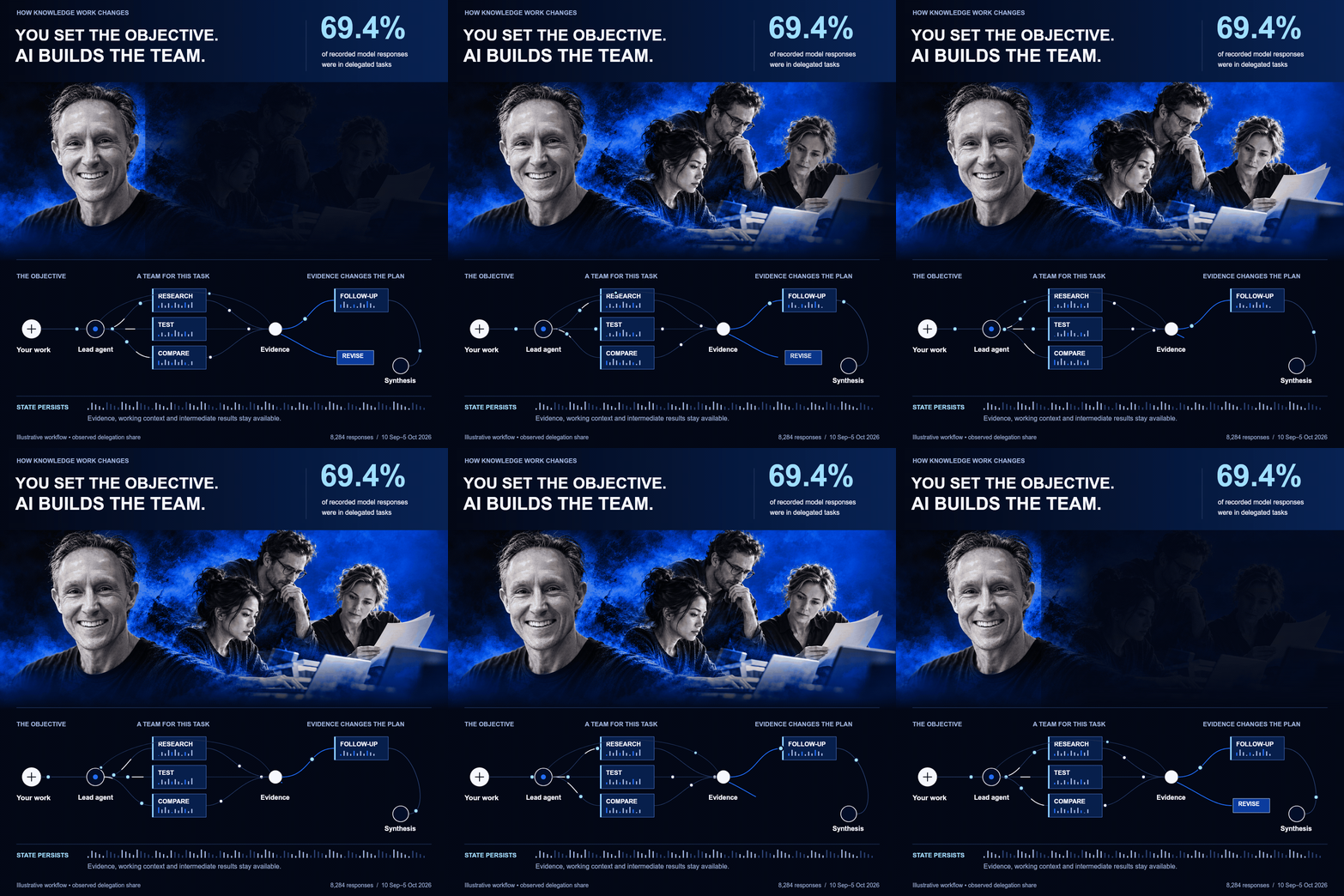
The study centred on one machine within our wider AI research setup. In a bounded archive linked to its research tasks, 25 task families encompassed 107 recorded histories. There were 8,284 model responses. Almost 70% occurred in delegated tasks.
One task family had recorded activity spanning 91.6 hours, involving 1,008 responses across four histories. That is elapsed time, including gaps and possible human steering, rather than an agent running uninterrupted for four days. Even with that distinction, the work plainly extended beyond a question and an answer.
I supplied objectives, standards and corrections. I did not design every investigation, hand-off or calculation in advance. The platform supplied the machinery; agents assembled substantial parts of the workflow as they went.
The division of labour was becoming part of the output.
Take a credit assessment.
DBS announced in August that approximately 1,500 employees had access to an agentic credit-assessment system, following a 150-person pilot. Specialised agents undertake more than 70 tasks, using annual reports, industry research and internal records to prepare a credit-memo draft. Bankers challenge and refine it; agents do further research. DBS's ambition to reduce preparation time by at least 30% is a target, not a reported result. [1]
Consider how an adaptive version of that work could proceed. This is an illustrative borrower review, not a description of DBS's undisclosed implementation.
The objective is to establish whether a borrower can service its debt, what has changed and which terms matter. One investigation reconciles the accounts. Another examines cash conversion. Another checks the lending agreements and amendments. Each returns evidence and questions.
Suppose earnings have improved but cash conversion has deteriorated. The system now has a reason to investigate receivables, working capital or financing arrangements. That additional work follows from a discovery. The person commissioning the assessment did not have to anticipate it.
Calculations run in a spreadsheet or code. Assumptions are challenged. A clarification arrives the next day, and the relevant analysis is updated. The result is a continuing analytical process, with a record of how it reached its conclusions.
The underlying mechanism is already documented. Anthropic describes research agents that devise a strategy, create specialist agents and revise the approach after their findings return. Hebbia describes financial-analysis evaluations in which the model writes instructions for its own subagents and tools. These are capabilities operating within designed systems; the particular investigation can still develop during execution. [2] [3]
This reaches into what firms buy, and what they employ people to produce.
Moody's describes a European bank that had outsourced credit-memo preparation and then introduced an agentic solution for a selected portfolio segment. It reports first drafts in less than 15 minutes against a previous preparation period of roughly two weeks. That is a vendor-reported result from an initial deployment. The interesting point is that an institution can bring an analytical production process in-house without necessarily recreating the outside provider's staffing model. [4]
There is also work that the old staffing model never made economical. More borrowers could be reviewed, more discrepancies investigated and more scenarios tested. A periodic assessment could become an assessment that is updated when relevant evidence changes. Whether each additional investigation is worth paying for remains the economic test.
Where memory enters the story.
Our audit found median recorded input of 126,045 tokens and median output of 216 tokens. Those are separate medians. Almost 95% of recorded input tokens were reported as cached.
The system was repeatedly using substantial context while producing relatively small increments of new output. A short response could be one step in a much longer undertaking.
Files and session records preserve evidence, calculations and unresolved questions. Cached model state can avoid rebuilding compatible earlier computation. They are different things, but both help the work survive individual model calls. Hebbia's persistent Projects similarly keep documents, analyses and generated work together; its background agents were introduced as a beta capability. [5]
For infrastructure, this means one person can commission considerably more computing activity than their visible interactions suggest. But the more important point is what that activity produces: a capacity to continue and organise knowledge work. Counting chatbot seats misses much of it.
Nor is “AI does the routine work; people do the thinking” an adequate description. Identifying a contradiction, choosing the next investigation and challenging an assumption are intellectual activities. Today's banks retain human review and decision authority. That is the operating arrangement today, not evidence that the boundary can never move.
There will be unnecessary branches, bad assumptions and work that fails review. A busy agent is no more proof of productivity than a busy office. The relevant measures are completed work, reliability, elapsed time and total cost.
But I would now ask a different question of an AI adoption plan: how much useful work could the business commission if people no longer had to organise and perform every intermediate step?
We are accustomed to drawing the organisation chart and then buying the software. An objective can now set a team of agents to work, with the division of labour changing as the investigation develops. That is a different way to produce knowledge work, and it is already happening.
Measurement note
The audit figures cover 8,284 unique recorded responses from 10 September–5 October 2026. They describe an archive linked to the audited research tasks. The one-machine framing describes the audit’s operational scope; the records do not establish where inference physically ran. The 107 histories were not necessarily simultaneous agents. Cached input is a subset of input; the cache percentage is token-weighted. This is an observational case study, not a controlled productivity experiment. Business content and underlying records remain private.
Sources
[2] Anthropic, How we built our multi-agent research system, 13 June 2025
[3] Anthropic/Hebbia, 13 July 2026